One of the things that still makes robots look robotic is the way they move. Jerky, mechanical, imprecise. A big part of that comes down to how they are built, servo motors crammed into joints, converting rotation into movement in a way that biological muscle simply does not. Researchers at MIT and Politecnico di Bari may have just found a better way.
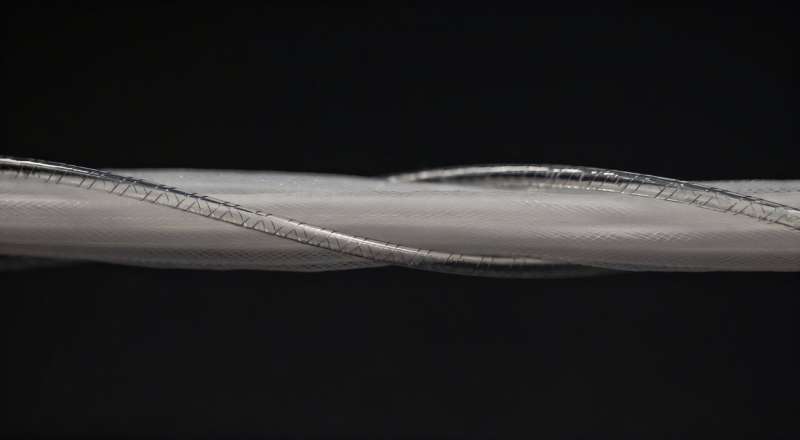
They developed what they call electrofluidic fiber muscles, tiny actuators about as thick as a toothpick that contract when electricity is applied, no motors, no external pumps, no noise. The whole thing works by injecting charge into a sealed dielectric fluid, which creates ions that move the fluid and generate pressure. The result is a fiber that behaves remarkably like real muscle.
What makes this genuinely exciting for robotics is not just that it contracts, it is that it can be distributed throughout a structure the same way muscle is in a body. Power density sits at around 50 watts per kilogram, on par with skeletal muscle, with a contraction response of 0.3 seconds. In tests, a bundle of these fibers lifted 4 kilograms, a woven version bent a robot arm 40 degrees, and a fast configuration launched objects in under a third of a second.
If this scales, the path to robots with real fine motor control gets a lot shorter. The bottleneck has always been the hardware. This starts to remove it.
why it matters
Most robots are built around servo motors that convert rotational force into linear motion and concentrate bulk near the joints. These fibers contract like real muscle and can be distributed throughout a structure. For exoskeletons and prosthetics, it’s the difference between gear you strap on and gear that moves with you.